Showing posts with label Illiad. Show all posts

Monday, June 30, 2014

Fifty Slaughtered in the Gloomy Vale

The Illiad
by Homer
This is the Alexander Pope translation.


We are journeying through Book 4. Previously
The tyrant feasting with his chiefs he found,
And dared to combat all those chiefs around:
Dared, and subdued before their haughty lord;
For Pallas strung his arm and edged his sword.
Stung with the shame, within the winding way,
To bar his passage fifty warriors lay;
Two heroes led the secret squadron on,
Mason the fierce, and hardy Lycophon;
Those fifty slaughter'd in the gloomy vale.
He spared but one to bear the dreadful tale,
Such Tydeus was, and such his martial fire;
Gods! how the son degenerates from the sire!"

Monday, June 23, 2014

Ulysses Stands Next to the Athenian Phalanx

The Illiad
by Homer
This is the Alexander Pope translation.


We are journeying through Book 4. Previously

He said. With joy the monarch march'd before,
And found Menestheus on the dusty shore,
With whom the firm Athenian phalanx stands;
And next Ulysses, with his subject bands.
Remote their forces lay, nor knew so far
The peace infringed, nor heard the sounds of war;
The tumult late begun, they stood intent
To watch the motion, dubious of the event.
The king, who saw their squadrons yet unmoved,
With hasty ardour thus the chiefs reproved:

Monday, June 16, 2014

O Heroes!

The Illiad
by Homer
This is the Alexander Pope translation.


We are journeying through Book 4. Previously

"O heroes! worthy such a dauntless train,
Whose godlike virtue we but urge in vain,
(Exclaim'd the king), who raise your eager bands
With great examples, more than loud commands.
Ah! would the gods but breathe in all the rest
Such souls as burn in your exalted breast,
Soon should our arms with just success be crown'd,
And Troy's proud walls lie smoking on the ground."

Monday, June 9, 2014

The Embattled Squadrons Stood

The Illiad
by Homer
This is the Alexander Pope translation.


We are journeying through Book 4. Previously

Thus with new ardour he the brave inspires;
Or thus the fearful with reproaches fires:
"Shame to your country, scandal of your kind;
Born to the fate ye well deserve to find!
Why stand ye gazing round the dreadful plain,
Prepared for flight, but doom'd to fly in vain?
Confused and panting thus, the hunted deer
Falls as he flies, a victim to his fear.
Still must ye wait the foes, and still retire,
Till yon tall vessels blaze with Trojan fire?
Or trust ye, Jove a valiant foe shall chase,
To save a trembling, heartless, dastard race?"

Monday, June 2, 2014

Jove Is With Greece

The Illiad
by Homer
This is the Alexander Pope translation.


We are journeying through Book 4. Previously

He said: a leader's and a brother's fears
Possess his soul, which thus the Spartan cheers:
"Let not thy words the warmth of Greece abate;
The feeble dart is guiltless of my fate:
Stiff with the rich embroider'd work around,
My varied belt repell'd the flying wound."

Monday, May 26, 2014

The Arrow Hits the King

The Illiad
by Homer
This is the Alexander Pope translation.


We are journeying through Book 4. Previously

Now with full force the yielding horn he bends,
Drawn to an arch, and joins the doubling ends;
Close to his breast he strains the nerve below,
Till the barb'd points approach the circling bow;
The impatient weapon whizzes on the wing;
Sounds the tough horn, and twangs the quivering string.

But thee, Atrides! in that dangerous hour
The gods forget not, nor thy guardian power,
Pallas assists, and (weakened in its force)
Diverts the weapon from its destined course:
So from her babe, when slumber seals his eye,
The watchful mother wafts the envenom'd fly.
Just where his belt with golden buckles join'd,
Where linen folds the double corslet lined,
She turn'd the shaft, which, hissing from above,
Pass'd the broad belt, and through the corslet drove;
The folds it pierced, the plaited linen tore,
And razed the skin, and drew the purple gore.
As when some stately trappings are decreed
To grace a monarch on his bounding steed,
A nymph in Caria or Maeonia bred,
Stains the pure ivory with a lively red;
With equal lustre various colours vie,
The shining whiteness, and the Tyrian dye:
So great Atrides! show'd thy sacred blood,
As down thy snowy thigh distill'd the streaming flood.
With horror seized, the king of men descried
The shaft infix'd, and saw the gushing tide:
Nor less the Spartan fear'd, before he found
The shining barb appear above the wound,
Then, with a sigh, that heaved his manly breast,
The royal brother thus his grief express'd,
And grasp'd his hand; while all the Greeks around
With answering sighs return'd the plaintive sound.

"Oh, dear as life! did I for this agree
The solemn truce, a fatal truce to thee!
Wert thou exposed to all the hostile train,
To fight for Greece, and conquer, to be slain!
The race of Trojans in thy ruin join,
And faith is scorn'd by all the perjured line.
Not thus our vows, confirm'd with wine and gore,
Those hands we plighted, and those oaths we swore,
Shall all be vain: when Heaven's revenge is slow,
Jove but prepares to strike the fiercer blow.
The day shall come, that great avenging day,
When Troy's proud glories in the dust shall lay,
When Priam's powers and Priam's self shall fall,
And one prodigious ruin swallow all.
I see the god, already, from the pole
Bare his red arm, and bid the thunder roll;
I see the Eternal all his fury shed,
And shake his aegis o'er their guilty head.
Such mighty woes on perjured princes wait;
But thou, alas! deserv'st a happier fate.
Still must I mourn the period of thy days,
And only mourn, without my share of praise?
Deprived of thee, the heartless Greeks no more
Shall dream of conquests on the hostile shore;
Troy seized of Helen, and our glory lost,
Thy bones shall moulder on a foreign coast;
While some proud Trojan thus insulting cries,
(And spurns the dust where Menelaus lies,)
'Such are the trophies Greece from Ilion brings,
And such the conquest of her king of kings!
Lo his proud vessels scatter'd o'er the main,
And unrevenged, his mighty brother slain.'
Oh! ere that dire disgrace shall blast my fame,
O'erwhelm me, earth! and hide a monarch's shame."


Continued next week. Tomorrow's installment from The Three Musketeers by Alexandre Dumas.

More About This Book


From the earliest days of Ancient Greece, the author(s) of this poem were contemporaries of the writers of the Bible's Old Testament.

Summary of Fourth Book: A quarrel in Olympus--Minerva goes down and persuades Fandarus to violate the oaths by wounding Menelaus with an arrow-- Agamemnon makes a speech and sends for Machaon--He then goes about among his captains and upbraids Ulysses and Sthenelus, who each of them retort fiercely--Diomed checks Sthenelus, and the two hosts then engage, with great slaughter on either side..

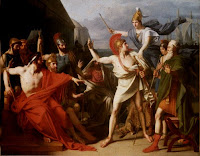
Painting: The Wrath of Achilles by Michael Drolling, 1819.

More information here:
About Homer and His PoemMore of This Series

Monday, May 19, 2014

Minerva Flies to Troy

The Illiad
by Homer
This is the Alexander Pope translation.


We are journeying through Book 4. Previously

The sire of men and monarch of the sky
The advice approved, and bade Minerva fly,
Dissolve the league, and all her arts employ
To make the breach the faithless act of Troy.
Fired with the charge, she headlong urged her flight,
And shot like lightning from Olympus' height.
As the red comet, from Saturnius sent
To fright the nations with a dire portent,
(A fatal sign to armies on the plain,
Or trembling sailors on the wintry main,)
With sweeping glories glides along in air,
And shakes the sparkles from its blazing hair:
Between both armies thus, in open sight
Shot the bright goddess in a trail of light,
With eyes erect the gazing hosts admire
The power descending, and the heavens on fire!
"The gods (they cried), the gods this signal sent,
And fate now labours with some vast event:
Jove seals the league, or bloodier scenes prepares;
Jove, the great arbiter of peace and wars."

They said, while Pallas through the Trojan throng,
(In shape a mortal,) pass'd disguised along.
Like bold Laodocus, her course she bent,
Who from Antenor traced his high descent.
Amidst the ranks Lycaon's son she found,
The warlike Pandarus, for strength renown'd;
Whose squadrons, led from black Æsepus' flood,
With flaming shields in martial circle stood.
To him the goddess: "Phrygian! canst thou hear
A well-timed counsel with a willing ear?
What praise were thine, couldst thou direct thy dart,
Amidst his triumph, to the Spartan's heart?
What gifts from Troy, from Paris wouldst thou gain,
Thy country's foe, the Grecian glory slain?
Then seize the occasion, dare the mighty deed,
Aim at his breast, and may that aim succeed!
But first, to speed the shaft, address thy vow
To Lycian Phoebus with the silver bow,
And swear the firstlings of thy flock to pay,
On Zelia's altars, to the god of day."

He heard, and madly at the motion pleased,
His polish'd bow with hasty rashness seized.
'Twas form'd of horn, and smooth'd with artful toil:
A mountain goat resign'd the shining spoil.
Who pierced long since beneath his arrows bled;
The stately quarry on the cliffs lay dead,
And sixteen palms his brow's large honours spread:
The workmen join'd, and shaped the bended horns,
And beaten gold each taper point adorns.
This, by the Greeks unseen, the warrior bends,
Screen'd by the shields of his surrounding friends:
There meditates the mark; and couching low,
Fits the sharp arrow to the well-strung bow.
One from a hundred feather'd deaths he chose,
Fated to wound, and cause of future woes;
Then offers vows with hecatombs to crown
Apollo's altars in his native town.


Continued next week. Tomorrow's installment from The Three Musketeers by Alexandre Dumas.

More About This Book


From the earliest days of Ancient Greece, the author(s) of this poem were contemporaries of the writers of the Bible's Old Testament.

Summary of Fourth Book: A quarrel in Olympus--Minerva goes down and persuades Fandarus to violate the oaths by wounding Menelaus with an arrow-- Agamemnon makes a speech and sends for Machaon--He then goes about among his captains and upbraids Ulysses and Sthenelus, who each of them retort fiercely--Diomed checks Sthenelus, and the two hosts then engage, with great slaughter on either side..

Painting: The Wrath of Achilles by Michael Drolling, 1819.

More information here:
About Homer and His PoemMore of This Series

Monday, May 12, 2014

The Council of the Gods

The Illiad
by Homer
This is the Alexander Pope translation.


We are journeying through Book 4. Previously

"Shall then, O tyrant of the ethereal reign!
My schemes, my labours, and my hopes be vain?
Have I, for this, shook Ilion with alarms,
Assembled nations, set two worlds in arms?
To spread the war, I flew from shore to shore;
The immortal coursers scarce the labour bore.
At length ripe vengeance o'er their heads impends,
But Jove himself the faithless race defends.
Loth as thou art to punish lawless lust,
Not all the gods are partial and unjust."

Monday, May 5, 2014

On Mount Olympus the Gods Argue

The Illiad
by Homer
This is the Alexander Pope translation.


We are journeying through Book 4. Previously

The same day continues through this as through the last book (as it does also through the two following, and almost to the end of the seventh book). The scene is wholly in the field before Troy.

And now Olympus' shining gates unfold;
  The gods, with Jove, assume their thrones of gold:
  Immortal Hebe, fresh with bloom divine,
  The golden goblet crowns with purple wine:
  While the full bowls flow round, the powers employ
  Their careful eyes on long-contended Troy. 

  When Jove, disposed to tempt Saturnia's spleen,
  Thus waked the fury of his partial queen,
  "Two powers divine the son of Atreus aid,
  Imperial Juno, and the martial maid;
  But high in heaven they sit, and gaze from far,
  The tame spectators of his deeds of war.
  Not thus fair Venus helps her favour'd knight,
  The queen of pleasures shares the toils of fight,
  Each danger wards, and constant in her care,
  Saves in the moment of the last despair.
  Her act has rescued Paris' forfeit life,
  Though great Atrides gain'd the glorious strife.
  Then say, ye powers! what signal issue waits
  To crown this deed, and finish all the fates!
  Shall Heaven by peace the bleeding kingdoms spare,
  Or rouse the furies, and awake the war?
  Yet, would the gods for human good provide,
  Atrides soon might gain his beauteous bride,
  Still Priam's walls in peaceful honours grow,
  And through his gates the crowding nations flow." 

  Thus while he spoke, the queen of heaven, enraged,
  And queen of war, in close consult engaged:
  Apart they sit, their deep designs employ,
  And meditate the future woes of Troy.
  Though secret anger swell'd Minerva's breast,
  The prudent goddess yet her wrath suppress'd;
  But Juno, impotent of passion, broke
  Her sullen silence, and with fury spoke:


Continued next week. Tomorrow's installment from The Three Musketeers by Alexandre Dumas.

More About This Book


From the earliest days of Ancient Greece, the author(s) of this poem were contemporaries of the writers of the Bible's Old Testament.

Summary of Fourth Book: A quarrel in Olympus--Minerva goes down and persuades Fandarus to violate the oaths by wounding Menelaus with an arrow-- Agamemnon makes a speech and sends for Machaon--He then goes about among his captains and upbraids Ulysses and Sthenelus, who each of them retort fiercely--Diomed checks Sthenelus, and the two hosts then engage, with great slaughter on either side..

Painting: The Wrath of Achilles by Michael Drolling, 1819.

More information here:
About Homer and His PoemMore of This Series

Monday, April 28, 2014

Venus Saves Alexandrus

The Illiad
by Homer


We are journeying through Book 3. Previously

He poised his spear as he spoke, and hurled it at the shield of Alexandrus. Through shield and cuirass it went, and tore the shirt by his flank, but Alexandrus swerved aside, and thus saved his life. Then the son of Atreus drew his sword, and drove at the projecting part of his helmet, but the sword fell shivered in three or four pieces from his hand, and he cried, looking towards Heaven, "Father Jove, of all gods thou art the most despiteful; I made sure of my revenge, but the sword has broken in my hand, my spear has been hurled in vain, and I have not killed him."

With this he flew at Alexandrus, caught him by the horsehair plume of his helmet, and began dragging him towards the Achaeans. The strap of the helmet that went under his chin was choking him, and Menelaus would have dragged him off to his own great glory had not Jove's daughter Venus been quick to mark and to break the strap of oxhide, so that the empty helmet came away in his hand. This he flung to his comrades among the Achaeans, and was again springing upon Alexandrus to run him through with a spear, but Venus snatched him up in a moment (as a god can do), hid him under a cloud of darkness, and conveyed him to his own bedchamber.

Then she went to call Helen, and found her on a high tower with the Trojan women crowding round her. She took the form of an old woman who used to dress wool for her when she was still in Lacedaemon, and of whom she was very fond. Thus disguised she plucked her by perfumed robe and said, "Come hither; Alexandrus says you are to go to the house; he is on his bed in his own room, radiant with beauty and dressed in gorgeous apparel. No one would think he had just come from fighting, but rather that he was going to a dance, or had done dancing and was sitting down."


Continued next week. Tomorrow's installment from The Three Musketeers by Alexandre Dumas.

More About This Book


From the earliest days of Ancient Greece, the author(s) of this poem were contemporaries of the writers of the Bible's Old Testament.

Summary of Third Book: Alexandria, also called Paris, challenges Menelaus--Helen and Priam view the Achaeans from the wall--The covenant--Paris and Menelaus fight, and Paris is worsted--Venus carries him off to save him--Scene between him and Helen.

Painting: The Wrath of Achilles by Michael Drolling, 1819.

More information here:
Check the right columnMore of This Series

Monday, January 28, 2013

The Trojan Champion’s Peril

The Illiad
by Homer


We are journeying through Book 3. Previously

Great Hector now turned his head aside while he shook the helmet, and the lot of Paris flew out first. The others took their several stations, each by his horses and the place where his arms were lying, while Alexandrus, husband of lovely Helen, put on his goodly armour. First he greaved his legs with greaves of good make and fitted with ancle-clasps of silver; after this he donned the cuirass of his brother Lycaon, and fitted it to his own body; he hung his silver-studded sword of bronze about his shoulders, and then his mighty shield. On his comely head he set his helmet, well-wrought, with a crest of horse-hair that nodded menacingly above it, and he grasped a redoubtable spear that suited his hands. In like fashion Menelaus also put on his armour.

When they had thus armed, each amid his own people, they strode fierce of aspect into the open space, and both Trojans and Achaeans were struck with awe as they beheld them. They stood near one another on the measured ground, brandishing their spears, and each furious against the other. Alexandrus aimed first, and struck the round shield of the son of Atreus, but the spear did not pierce it, for the shield turned its point. Menelaus next took aim, praying to Father Jove as he did so. "King Jove," he said, "grant me revenge on Alexandrus who has wronged me; subdue him under my hand that in ages yet to come a man may shrink from doing ill deeds in the house of his host."


Continued next week. Tomorrow's installment from The Three Musketeers by Alexandre Dumas.

More About This Book


From the earliest days of Ancient Greece, the author(s) of this poem were contemporaries of the writers of the Bible's Old Testament.

Summary of Third Book: Alexandria, also called Paris, challenges Menelaus--Helen and Priam view the Achaeans from the wall--The covenant--Paris and Menelaus fight, and Paris is worsted--Venus carries him off to save him--Scene between him and Helen.

Painting: The Wrath of Achilles by Michael Drolling, 1819.

More information here:
Check the right columnMore of This Series

Monday, January 21, 2013

Preliminaries of Battle

The Illiad
by Homer


We are journeying through Book 3. Previously

As he spoke he drew his knife across the throats of the victims, and laid them down gasping and dying upon the ground, for the knife had reft them of their strength. Then they poured wine from the mixing-bowl into the cups, and prayed to the everlasting gods, saying, Trojans and Achaeans among one another, "Jove, most great and glorious, and ye other everlasting gods, grant that the brains of them who shall first sin against their oaths--of them and their children--may be shed upon the ground even as this wine, and let their wives become the slaves of strangers."

Thus they prayed, but not as yet would Jove grant them their prayer. Then Priam, descendant of Dardanus, spoke, saying, "Hear me, Trojans and Achaeans, I will now go back to the wind-beaten city of Ilius: I dare not with my own eyes witness this fight between my son and Menelaus, for Jove and the other immortals alone know which shall fall." On this he laid the two lambs on his chariot and took his seat. He gathered the reins in his hand, and Antenor sat beside him; the two then went back to Ilius. Hector and Ulysses measured the ground, and cast lots from a helmet of bronze to see which should take aim first. Meanwhile the two hosts lifted up their hands and prayed saying, "Father Jove, that rulest from Ida, most glorious in power, grant that he who first brought about this war between us may die, and enter the house of Hades, while we others remain at peace and abide by our oaths."


Continued next week. Tomorrow's installment from The Three Musketeers by Alexandre Dumas.

More About This Book


From the earliest days of Ancient Greece, the author(s) of this poem were contemporaries of the writers of the Bible's Old Testament.

Summary of Third Book: Alexandria, also called Paris, challenges Menelaus--Helen and Priam view the Achaeans from the wall--The covenant--Paris and Menelaus fight, and Paris is worsted--Venus carries him off to save him--Scene between him and Helen.

Painting: The Wrath of Achilles by Michael Drolling, 1819.

More information here:
Check the right columnMore of This Series

Monday, January 14, 2013

Here’s the Deal

The Illiad
by Homer


We are journeying through Book 3. Previously

The old man trembled as he heard, but bade his followers yoke the horses, and they made all haste to do so. He mounted the chariot, gathered the reins in his hand, and Antenor took his seat beside him; they then drove through the Scaean gates on to the plain. When they reached the ranks of the Trojans and Achaeans they left the chariot, and with measured pace advanced into the space between the hosts. Agamemnon and Ulysses both rose to meet them. The attendants brought on the oath-offerings and mixed the wine in the mixing-bowls; they poured water over the hands of the chieftains, and the son of Atreus drew the dagger that hung by his sword, and cut wool from the lambs' heads; this the men-servants gave about among the Trojan and Achaean princes, and the son of Atreus lifted up his hands in prayer. "Father Jove," he cried, "that rulest in Ida, most glorious in power, and thou oh Sun, that seest and givest ear to all things, Earth and Rivers, and ye who in the realms below chastise the soul of him that has broken his oath, witness these rites and guard them, that they be not vain. If Alexandrus kills Menelaus, let him keep Helen and all her wealth, while we sail home with our ships; but if Menelaus kills Alexandrus, let the Trojans give back Helen and all that she has; let them moreover pay such fine to the Achaeans as shall be agreed upon, in testimony among those that shall be born hereafter. And if Priam and his sons refuse such fine when Alexandrus has fallen, then will I stay here and fight on till I have got satisfaction."


Continued next week. Tomorrow's installment from The Three Musketeers by Alexandre Dumas.

More About This Book


From the earliest days of Ancient Greece, the author(s) of this poem were contemporaries of the writers of the Bible's Old Testament.

Summary of Third Book: Alexandria, also called Paris, challenges Menelaus--Helen and Priam view the Achaeans from the wall--The covenant--Paris and Menelaus fight, and Paris is worsted--Venus carries him off to save him--Scene between him and Helen.

Painting: The Wrath of Achilles by Michael Drolling, 1819.

More information here:
Check the right columnMore of This Series

Monday, January 7, 2013

Settle the War by Single Combat

The Illiad
by Homer


We are journeying through Book 3. Previously

"That," answered Helen, "is huge Ajax, bulwark of the Achaeans, and on the other side of him, among the Cretans, stands Idomeneus looking like a god, and with the captains of the Cretans round him. Often did Menelaus receive him as a guest in our house when he came visiting us from Crete. I see, moreover, many other Achaeans whose names I could tell you, but there are two whom I can nowhere find, Castor, breaker of horses, and Pollux the mighty boxer; they are children of my mother, and own brothers to myself. Either they have not left Lacedaemon, or else, though they have brought their ships, they will not show themselves in battle for the shame and disgrace that I have brought upon them."

She knew not that both these heroes were already lying under the earth in their own land of Lacedaemon.

Meanwhile the heralds were bringing the holy oath-offerings through the city--two lambs and a goatskin of wine, the gift of earth; and Idaeus brought the mixing bowl and the cups of gold. He went up to Priam and said, "Son of Laomedon, the princes of the Trojans and Achaeans bid you come down on to the plain and swear to a solemn covenant. Alexandrus and Menelaus are to fight for Helen in single combat, that she and all her wealth may go with him who is the victor. We are to swear to a solemn covenant of peace whereby we others shall dwell here in Troy, while the Achaeans return to Argos and the land of the Achaeans."


Continued next week. Tomorrow's installment from The Three Musketeers by Alexandre Dumas.

More About This Book


From the earliest days of Ancient Greece, the author(s) of this poem were contemporaries of the writers of the Bible's Old Testament.

Summary of Third Book: Alexandria, also called Paris, challenges Menelaus--Helen and Priam view the Achaeans from the wall--The covenant--Paris and Menelaus fight, and Paris is worsted--Venus carries him off to save him--Scene between him and Helen.

Painting: The Wrath of Achilles by Michael Drolling, 1819.

More information here:
Check the right columnMore of This Series

Monday, December 31, 2012

That’s Ulysses; Now Who’s Ajax?

The Illiad
by Homer


We are journeying through Book 3. Previously

On this Antenor said, "Madam, you have spoken truly. Ulysses once came here as envoy about yourself, and Menelaus with him. I received them in my own house, and therefore know both of them by sight and conversation. When they stood up in presence of the assembled Trojans, Menelaus was the broader shouldered, but when both were seated Ulysses had the more royal presence. After a time they delivered their message, and the speech of Menelaus ran trippingly on the tongue; he did not say much, for he was a man of few words, but he spoke very clearly and to the point, though he was the younger man of the two; Ulysses, on the other hand, when he rose to speak, was at first silent and kept his eyes fixed upon the ground. There was no play nor graceful movement of his sceptre; he kept it straight and stiff like a man unpracticed in oratory--one might have taken him for a mere churl or simpleton; but when he raised his voice, and the words came driving from his deep chest like winter snow before the wind, then there was none to touch him, and no man thought further of what he looked like."

Priam then caught sight of Ajax and asked, "Who is that great and goodly warrior whose head and broad shoulders tower above the rest of the Argives?"


Continued next week. Tomorrow's installment from The Three Musketeers by Alexandre Dumas.

More About This Book


From the earliest days of Ancient Greece, the author(s) of this poem were contemporaries of the writers of the Bible's Old Testament.

Summary of Third Book: Alexandria, also called Paris, challenges Menelaus--Helen and Priam view the Achaeans from the wall--The covenant--Paris and Menelaus fight, and Paris is worsted--Venus carries him off to save him--Scene between him and Helen.

Painting: The Wrath of Achilles by Michael Drolling, 1819.

More information here:
Check the right columnMore of This Series

Monday, June 25, 2012

Helen Identifies Ulysses for the Trojans

The Illiad
by Homer


We are journeying through Book 3. Previously

The old man marvelled at him and said, "Happy son of Atreus, child of good fortune. I see that the Achaeans are subject to you in great multitudes. When I was in Phrygia I saw much horsemen, the people of Otreus and of Mygdon, who were camping upon the banks of the river Sangarius; I was their ally, and with them when the Amazons, peers of men, came up against them, but even they were not so many as the Achaeans."

The old man next looked upon Ulysses; "Tell me," he said, "who is that other, shorter by a head than Agamemnon, but broader across the chest and shoulders? His armour is laid upon the ground, and he stalks in front of the ranks as it were some great woolly ram ordering his ewes."

And Helen answered, "He is Ulysses, a man of great craft, son of Laertes. He was born in rugged Ithaca, and excels in all manner of stratagems and subtle cunning."


Continued next week. Tomorrow's installment from The Three Musketeers by Alexandre Dumas.

More About This Book


From the earliest days of Ancient Greece, the author(s) of this poem were contemporaries of the writers of the Bible's Old Testament.

Summary of Third Book: Alexandria, also called Paris, challenges Menelaus--Helen and Priam view the Achaeans from the wall--The covenant--Paris and Menelaus fight, and Paris is worsted--Venus carries him off to save him--Scene between him and Helen.

Painting: The Wrath of Achilles by Michael Drolling, 1819.

More information here:
Check the right columnMore of This Series

Monday, June 18, 2012

Helen’s Sorrow – and Troy’s

The Illiad
by Homer


We are journeying through Book 3. Previously

The two sages, Ucalegon and Antenor, elders of the people, were seated by the Scaean gates, with Priam, Panthous, Thymoetes, Lampus, Clytius, and Hiketaon of the race of Mars. These were too old to fight, but they were fluent orators, and sat on the tower like cicales that chirrup delicately from the boughs of some high tree in a wood. When they saw Helen coming towards the tower, they said softly to one another, "Small wonder that Trojans and Achaeans should endure so much and so long, for the sake of a woman so marvellously and divinely lovely. Still, fair though she be, let them take her and go, or she will breed sorrow for us and for our children after us."

But Priam bade her draw nigh. "My child," said he, "take your seat in front of me that you may see your former husband, your kinsmen and your friends. I lay no blame upon you, it is the gods, not you who are to blame. It is they that have brought about this terrible war with the Achaeans. Tell me, then, who is yonder huge hero so great and goodly? I have seen men taller by a head, but none so comely and so royal. Surely he must be a king."

"Sir," answered Helen, "father of my husband, dear and reverend in my eyes, would that I had chosen death rather than to have come here with your son, far from my bridal chamber, my friends, my darling daughter, and all the companions of my girlhood. But it was not to be, and my lot is one of tears and sorrow. As for your question, the hero of whom you ask is Agamemnon, son of Atreus, a good king and a brave soldier, brother-in-law as surely as that he lives, to my abhorred and miserable self."


Continued next week. Tomorrow's installment from The Three Musketeers by Alexandre Dumas.

More About This Book


From the earliest days of Ancient Greece, the author(s) of this poem were contemporaries of the writers of the Bible's Old Testament.

Summary of Third Book: Alexandria, also called Paris, challenges Menelaus--Helen and Priam view the Achaeans from the wall--The covenant--Paris and Menelaus fight, and Paris is worsted--Venus carries him off to save him--Scene between him and Helen.

Painting: The Wrath of Achilles by Michael Drolling, 1819.

More information here:
Check the right columnMore of This Series

Monday, June 11, 2012

A Goddess Speaks to Helen

The Illiad
by Homer


We are journeying through Book 3. Previously

The Trojans and Achaeans were glad when they heard this, for they thought that they should now have rest. They backed their chariots toward the ranks, got out of them, and put off their armour, laying it down upon the ground; and the hosts were near to one another with a little space between them. Hector sent two messengers to the city to bring the lambs and to bid Priam come, while Agamemnon told Talthybius to fetch the other lamb from the ships, and he did as Agamemnon had said.

Meanwhile Iris went to Helen in the form of her sister-in-law, wife of the son of Antenor, for Helicaon, son of Antenor, had married Laodice, the fairest of Priam's daughters. She found her in her own room, working at a great web of purple linen, on which she was embroidering the battles between Trojans and Achaeans, that Mars had made them fight for her sake. Iris then came close up to her and said, "Come hither, child, and see the strange doings of the Trojans and Achaeans. Till now they have been warring upon the plain, mad with lust of battle, but now they have left off fighting, and are leaning upon their shields, sitting still with their spears planted beside them. Alexandrus and Menelaus are going to fight about yourself, and you are to be the wife of him who is the victor."

Thus spoke the goddess, and Helen's heart yearned after her former husband, her city, and her parents. She threw a white mantle over her head, and hurried from her room, weeping as she went, not alone, but attended by two of her handmaids, Aethrae, daughter of Pittheus, and Clymene. And straightway they were at the Scaean gates.


Continued next week. Tomorrow's installment from The Three Musketeers by Alexandre Dumas.


More About This Book


From the earliest days of Ancient Greece, the author(s) of this poem were contemporaries of the writers of the Bible's Old Testament.

Summary of Third Book: Alexandria, also called Paris, challenges Menelaus--Helen and Priam view the Achaeans from the wall--The covenant--Paris and Menelaus fight, and Paris is worsted--Venus carries him off to save him--Scene between him and Helen.

Painting: The Wrath of Achilles by Michael Drolling, 1819.

More information here:
Check the right columnMore of This Series

Monday, June 4, 2012

Menelaus Answers Hector’s Proposal


The Illiad
by Homer


We are journeying through Book 3. Previously

When Hector heard this he was glad, and went about among the Trojan ranks holding his spear by the middle to keep them back, and they all sat down at his bidding: but the Achaeans still aimed at him with stones and arrows, till Agamemnon shouted to them saying, "Hold, Argives, shoot not, sons of the Achaeans; Hector desires to speak."

They ceased taking aim and were still, whereon Hector spoke. "Hear from my mouth," said he, "Trojans and Achaeans, the saying of Alexandrus, through whom this quarrel has come about. He bids the Trojans and Achaeans lay their armour upon the ground, while he and Menelaus fight in the midst of you for Helen and all her wealth. Let him who shall be victorious and prove to be the better man take the woman and all she has, to bear them to his own home, but let the rest swear to a solemn covenant of peace."

Thus he spoke, and they all held their peace, till Menelaus of the loud battle-cry addressed them. "And now," he said, "hear me too, for it is I who am the most aggrieved. I deem that the parting of Achaeans and Trojans is at hand, as well it may be, seeing how much have suffered for my quarrel with Alexandrus and the wrong he did me. Let him who shall die, die, and let the others fight no more. Bring, then, two lambs, a white ram and a black ewe, for Earth and Sun, and we will bring a third for Jove. Moreover, you shall bid Priam come, that he may swear to the covenant himself; for his sons are high-handed and ill to trust, and the oaths of Jove must not be transgressed or taken in vain. Young men's minds are light as air, but when an old man comes he looks before and after, deeming that which shall be fairest upon both sides."


Continued next week. Tomorrow's installment from The Three Musketeers by Alexandre Dumas.


More About This Book


From the earliest days of Ancient Greece, the author(s) of this poem were contemporaries of the writers of the Bible's Old Testament.

Summary of Third Book: Alexandria, also called Paris, challenges Menelaus--Helen and Priam view the Achaeans from the wall--The covenant--Paris and Menelaus fight, and Paris is worsted--Venus carries him off to save him--Scene between him and Helen.

Painting: The Wrath of Achilles by Michael Drolling, 1819.

More information here:
Check the right columnMore of This Series

Monday, December 26, 2011

The Illiad - Book Three - 2

by Homer


Alexandrus quailed as he saw Menelaus come forward, and shrank in
fear of his life under cover of his men. As one who starts back
affrighted, trembling and pale, when he comes suddenly upon a
serpent in some mountain glade, even so did Alexandrus plunge
into the throng of Trojan warriors, terror-stricken at the sight
of the son of Atreus.

Then Hector upbraided him. "Paris," said he, "evil-hearted Paris,
fair to see, but woman-mad, and false of tongue, would that you
had never been born, or that you had died unwed. Better so, than
live to be disgraced and looked askance at. Will not the Achaeans
mock at us and say that we have sent one to champion us who is
fair to see but who has neither wit nor courage? Did you not,
such as you are, get your following together and sail beyond the
seas? Did you not from your a far country carry off a lovely
woman wedded among a people of warriors--to bring sorrow upon
your father, your city, and your whole country, but joy to your
enemies, and hang-dog shamefacedness to yourself? And now can you
not dare face Menelaus and learn what manner of man he is whose
wife you have stolen? Where indeed would be your lyre and your
love-tricks, your comely locks and your fair favour, when you
were lying in the dust before him? The Trojans are a weak-kneed
people, or ere this you would have had a shirt of stones for the
wrongs you have done them."

And Alexandrus answered, "Hector, your rebuke is just. You are
hard as the axe which a shipwright wields at his work, and
cleaves the timber to his liking. As the axe in his hand, so keen
is the edge of your scorn. Still, taunt me not with the gifts
that golden Venus has given me; they are precious; let not a man
disdain them, for the gods give them where they are minded, and
none can have them for the asking. If you would have me do battle
with Menelaus, bid the Trojans and Achaeans take their seats,
while he and I fight in their midst for Helen and all her wealth.
Let him who shall be victorious and prove to be the better man
take the woman and all she has, to bear them to his home, but let
the rest swear to a solemn covenant of peace whereby you Trojans
shall stay here in Troy, while the others go home to Argos and
the land of the Achaeans."


Continued next week. Tomorrow's installment from The Three Musketeers by Alexandre Dumas.

More About This Book


From the earliest days of Ancient Greece, the author(s) of this poem were contemporaries of the writers of the Bible's Old Testament.

Summary of Third Book: Alexandria, also called Paris, challenges Menelaus--Helen and Priam view the Achaeans from the wall--The covenant--Paris and Menelaus fight, and Paris is worsted--Venus carries him off to save him--Scene between him and Helen.

Painting: The Wrath of Achilles by Michael Drolling, 1819.

More information here:
Check the right columnMore of This Series